
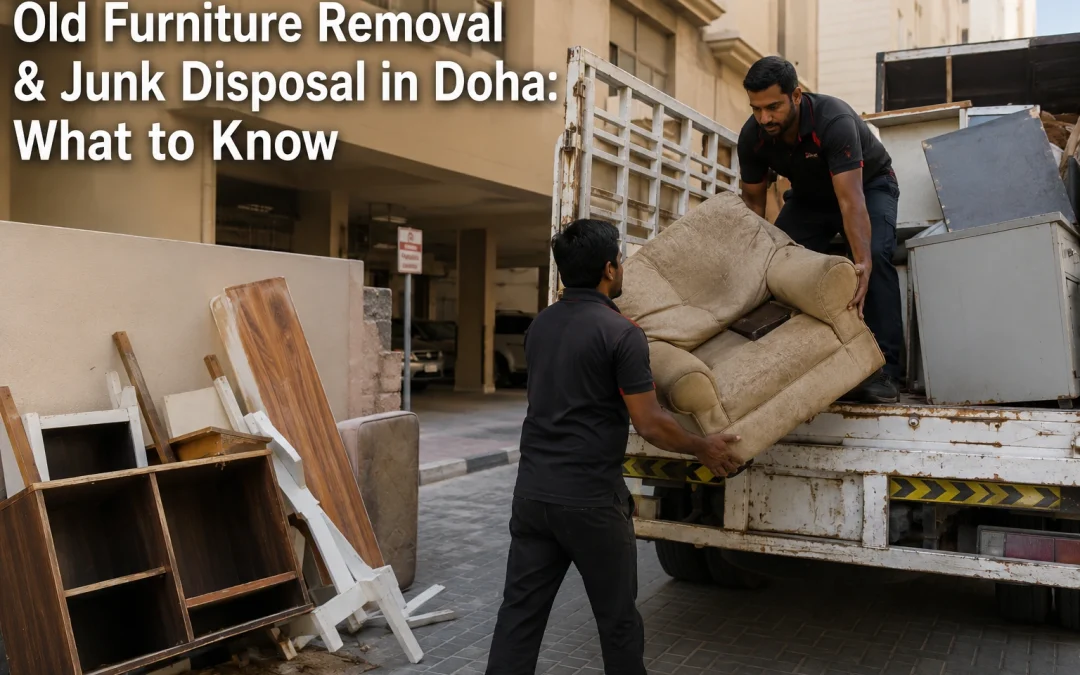
If you have lived in Doha for more than one lease cycle, you already know the scene.
It is the end of June. The compound in Al Sadd or Muaither is emptying out. Beside the skip near the gate, someone has left a three-seater sofa, a broken wardrobe with the mirror still attached, and a mattress leaning against the wall. It sits there for four days. Then a week. The cleaners will not touch it, because it is not their job. The next tenant moves in and the sofa is still there, now bleached grey by the sun.
Nobody who left it there thought they were doing anything wrong. That is the part worth talking about.
The problem nobody explains to you when you sign a lease
Qatar’s housing market runs on cycles. Contracts end, families relocate, employees rotate home, and villas change hands. Every one of those transitions produces the same thing: furniture that the next person does not want and the current person cannot take.
And here is where almost everyone makes the same assumption — that a sofa is basically just very large rubbish, and that leaving it beside the bin is the same as putting a bag in the bin.
It is not. Legally, it is a completely different act.
What the law actually says
Qatar’s public cleanliness framework is set out in Law No. 18 of 2017 on Public Hygiene, which replaced the older 1974 legislation and was later amended by Law No. 6 of 2023. Most residents have never read it. The penalties are steeper than people expect.
Under this law, disposing of waste anywhere other than the location designated by the competent municipality can carry a fine reaching QR 25,000, along with a possible jail term of up to six months. Dumping waste in public areas and in the common areas of private buildings — corridors, parking areas, rooftops, the space beside your building’s bins — carries penalties of up to QR 10,000.
Two details from the law matter enormously and almost never get mentioned:
First, “private” does not mean exempt. The law explicitly covers the shared spaces of private buildings. Your compound’s parking area is not a legal grey zone. Neither is the patch of sand behind the villa.
Second, the municipality can clean it up and bill you. If a violator does not remove the waste within the period the municipality sets, the municipality removes it and charges the offender for the cost. So the sofa does not just risk a fine — it can also generate an invoice.
Enforcement has also become considerably less theoretical. The Ministry has publicly discussed monitoring public hygiene violations using the Ministry of Interior’s National Command Center camera network, and runs regular public awareness campaigns listing specific violations and their penalties.
The old assumption that nobody is really watching an empty plot at 11pm is a much weaker assumption than it was ten years ago.
Where your old furniture is actually supposed to go
Qatar’s waste system is genuinely well built. This is not a country with a disposal problem — it is a country where residents do not know how to plug into the system.
Household waste across Qatar flows to the Domestic Solid Waste Management Centre (DSWMC) in Mesaieed, which opened in 2011 as the first integrated solid waste facility in the Middle East. It handles roughly 2,200 to 2,300 tonnes per day and does considerably more than bury things. According to the Ministry of Municipality’s 2025 annual report, the centre generated approximately 249,568 megawatt-hours of electricity from waste-to-energy operations that year and produced more than 32,000 tonnes of organic compost, alongside recovery of plastics and ferrous and non-ferrous metals.
Feeding into it are waste transfer stations positioned around the country — South Doha, West Doha, the Industrial Area, Dukhan and Al Khor — which consolidate loads before transport.
A World Bank assessment reported in 2026 placed Qatar among the region’s strongest performers in waste management, specifically citing this integrated infrastructure.
So the system works. The gap is the last mile — getting a wardrobe from a third-floor apartment in Najma to a transfer station in a country where most residents do not own a pickup truck.
The three real options, honestly compared
| What it costs | What it actually takes | Realistic for | |
|---|---|---|---|
| Do it yourself | Truck rental plus fuel | Dismantling, carrying down stairs, loading, driving to a transfer station, unloading — usually a full day, and you need at least two people | Someone with a vehicle, free time, and one or two light items |
| Municipality bulky pickup | Free | Scheduling through your municipality and waiting for the collection window | Residents who are not on a deadline |
| Private removal service | A quoted fee, sometimes offset by resale value | One phone call | Anyone working to a handover date |
There is no universally correct answer here. If you have a single broken chair and a friend with a pickup, the first option is fine. If you are handing keys back to a landlord on Thursday and you have a full villa to clear, it is not.
The mistake is drifting into a fourth option by default — leaving it beside the bin because the other three felt like too much effort. That is the one with the QR 25,000 ceiling attached.
What separates a proper removal service from a man with a truck
Doha has no shortage of people who will take your furniture away for a fee. Where it goes afterwards is a different question, and it is one you should ask directly — because under Qatari law, responsibility for improperly disposed waste does not simply evaporate the moment it leaves your gate.
Before you book anyone, it is worth checking five things:
Where does it end up? A legitimate operator can tell you which transfer station or facility they use. An evasive answer usually means an empty plot somewhere in the industrial area.
Do they sort, or just dump? Serviceable furniture, metal and appliances have recovery value. An operator who separates them is doing the environmentally sound thing — and often passing some of that value back to you.
Will they dismantle and carry? A wardrobe that does not fit through the door is the single most common reason a “removal” turns into a half-finished job. Ask before, not after.
Is the quote complete? Floor level, stair access, item count and distance all affect real cost. A quote that ignores them is a quote that will change on the day.
Can they actually come when you need them? Handover dates do not move. A service that cannot commit to a date is not a service you can plan around.
For residents who want a single point of contact for this, old furniture removal and junk disposal in Doha is handled as a dedicated service rather than an afterthought bolted onto a general cleaning contract — which is generally what you want when there is a deadline involved.

The part most people discover too late: removal and moving are the same job
Here is a pattern anyone who has moved within Doha will recognise.
You book a moving company for Thursday. You plan to deal with the old sofa, the dead fridge and the broken bed frame “before then”. Thursday arrives. The movers are loading. The junk is still sitting in the second bedroom, and now it is your problem to solve in the four hours before the landlord’s inspection.
The two jobs are not separate jobs. They are two halves of the same day. Splitting them between two companies means two schedules, two quotes, two teams who blame each other, and one gap that falls to you.
This is why it usually makes sense to handle relocation and disposal through the same provider. When packers and movers services and junk removal come from one team, the sequencing works: the discards go out first, the packing happens in clear space, and the property is handed back empty in a single visit rather than three.
Why Doha Home Fix is worth a call
Everything above applies regardless of who you hire. But since you are reading this on the strength of practical advice rather than a sales pitch, here is the honest case.
Nine years in this market. Doha Home Fix has been working in Qatar since 2016. That is long enough to know which transfer station is quickest from West Bay on a Thursday afternoon, and how compound management in different areas handles access for removal trucks. That knowledge is not on any website — it is accumulated.
They buy as well as remove. This is the genuine differentiator. A large share of what residents discard is not junk at all: it is serviceable furniture that a new arrival would happily buy. Doha Home Fix buys used furniture and old or scrap AC units at market rates and pays on the spot. In practice this means a villa clearance frequently costs far less than the quoted removal fee — and sometimes ends with money going the other direction. Ask for the buy-back assessment before you accept a removal quote. Most companies will not offer one, because most companies do not have a resale channel.
Seven services, one team. Removal, packers and movers, carpentry, plumbing, AC repair, sofa upholstery, and curtains and sofa making. For a move-out that involves patching a wall, disconnecting a split unit and clearing three rooms, that is one number instead of four.
Transparent quoting. Free upfront quotes covering floor level, access and item count, with no charges added on the day.
Real coverage. Lusail, The Pearl, West Bay, Al Sadd, Al Wakrah, Al Rayyan, Al Khor, Al Gharafa, Madinat Khalifa, Umm Salal and across Qatar.
A guarantee that means something. Work is backed by a service guarantee — if an issue returns after a repair, the team comes back at no additional charge.
You can see the full range of services at Doha Home Fix, or call +974 7446 9660 for a quote. WhatsApp with a few photos of what needs to go is usually the fastest route to a number.
Frequently asked questions
Can I just leave old furniture next to the bins in my compound?
No. Law No. 18 of 2017 covers common areas of private buildings, including parking areas and corridors. Penalties reach QR 10,000 for dumping in these areas, and up to QR 25,000 for disposal outside locations designated by the municipality. The municipality can also remove the items and charge you for the cost.
Is there a free option?
Yes — municipalities operate bulky waste collection. It is free but runs on their schedule, which does not always align with a lease handover date.
What happens to furniture after it is collected?
Household waste in Qatar goes to the Domestic Solid Waste Management Centre in Mesaieed via regional transfer stations, where recoverable materials are separated and organic content is composted or converted to energy. Furniture in usable condition is better diverted to resale before it enters that stream at all.
Can I sell old furniture instead of paying to remove it?
Often, yes. Sofas, wardrobes, dining sets, beds and working appliances usually retain resale value. Doha Home Fix buys used furniture and old AC units and pays on the spot, which can offset or eliminate the removal cost entirely.
How much notice is needed?
Same-day service is frequently available, and jobs booked before noon are often completed that day. For a full villa clearance tied to a handover date, giving two or three days’ notice makes the day run considerably more smoothly.
Doha Home Fix has provided home maintenance and clearance services across Qatar since 2016. Call +974 7446 9660 or visit dohahomefix.com.